Best VR Games for Beginners: Gentle First Picks on Quest, PS VR2 and PC
Comfortable, well-established VR games for your first weeks in a headset, grouped by play style, with platform availability for Quest, PS VR2 and PC VR.
The first games you play in VR shape how you feel about the whole medium. Start with something that throws you around a rollercoaster or slides you across a battlefield with a thumbstick, and there is a real chance you will finish the session queasy and put the headset back in its box. Start with something that keeps you comfortable while showing off what VR does best, and you are far more likely to come back.
This list focuses on gentle first picks: established games where you mostly stay in one place, move by teleporting or move only with your own body. Each entry explains why it suits newcomers and which platforms it is on. Availability was checked against official stores and publisher announcements as of October 2026, but storefronts change, so confirm on your platform before buying.
What makes a good first VR game
Before the list, it helps to know what to look for, because the same principles will guide you long after you have played these games.
- Stationary or teleport movement. Discomfort in VR usually comes from your eyes seeing movement your body does not feel, especially smooth thumbstick movement and turning. Games where you stand still, or move by teleporting, avoid most of this. Our guide to VR motion sickness explains the mechanics.
- Hand-based interaction. The magic of VR is reaching out and picking things up. Games that are built around grabbing, throwing and manipulating objects teach you how VR controls work.
- Short levels or sessions. Early on, sessions of 15 to 30 minutes are sensible. Games that break into short chunks let you stop without losing progress.
- Low pressure. Being chased or rushed while still learning the controls is stressful. Calm or self-paced games give you room to explore.
Free starting points that come with your headset
First Encounters (Meta Quest 3)
Meta includes First Encounters on the Quest 3. It is a short mixed reality game in which your own room is gradually opened up by alien creatures, which you capture as they appear. Because it uses passthrough, you can see your real surroundings throughout, which makes it reassuring for first-timers and a good demonstration of what the headset’s cameras can do. It relies on the Quest 3’s depth sensing, so it is not available on older Quest models.
The tutorials themselves
Every major headset includes an onboarding tutorial that teaches controller basics. It is tempting to skip them, but they are designed for exactly this moment. If you are setting up a Quest, our Quest setup guide walks through the first steps; on PlayStation VR2, the setup process includes an introduction to the Sense controllers.
Stationary, hands-on comedy and puzzles
Job Simulator
Platforms: Meta Quest, PS VR2, PC VR (Steam)
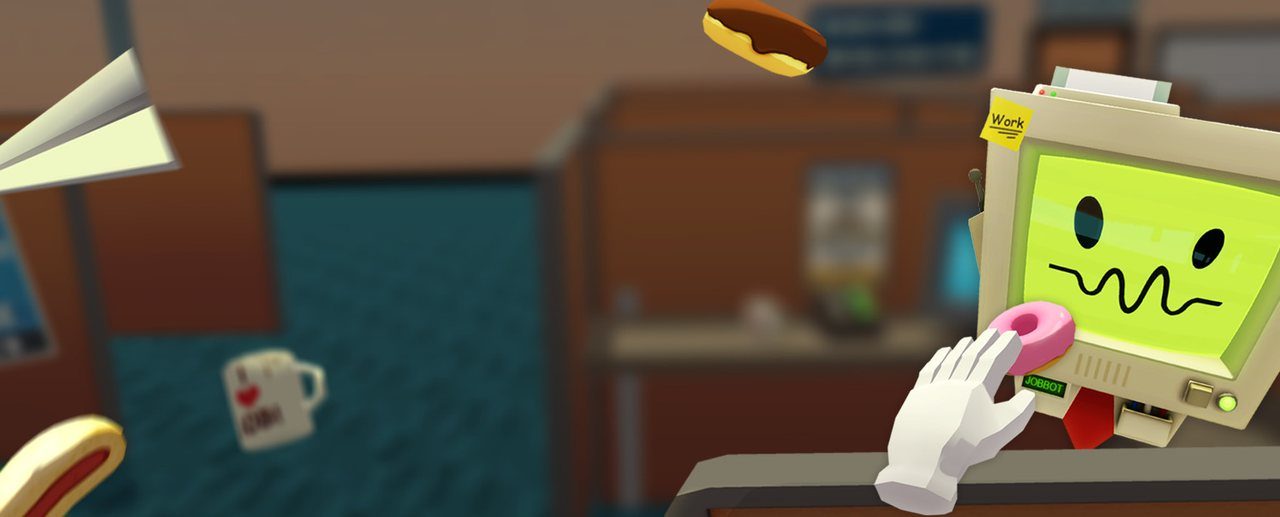
Owlchemy Labs’ Job Simulator is set in a future where robots have replaced human workers and are now curious about what “jobbing” was like. You perform comic versions of jobs, such as gourmet chef, office worker and convenience store clerk, in small rooms where nearly everything can be picked up, thrown or combined. You barely need to move, and the game teaches natural hand interaction better than almost anything else. It is also a favorite for introducing non-gamers to VR because there are no complicated controls to learn. The PlayStation Store version includes both PS VR and PS VR2 editions.
Puzzling Places
Platforms: Meta Quest, PS VR2, PC VR (Steam)
Realities.io’s Puzzling Places is a 3D jigsaw puzzle game built from photographic scans of real buildings and places around the world. You assemble the pieces in front of you, usually while seated, and watch a miniature location take shape. It is calm, completely comfortable and ideal for short sessions. The PS VR2 version arrived in 2023, and the game launched on Steam in 2026.
Rhythm games: active but stationary
Rhythm games are some of the most popular VR genres, and the best ones are comfortable because the world comes to you while you stay in place.

Beat Saber
Platforms: Meta Quest, PC VR (Steam); also PS VR and PS VR2 (see note)
In Beat Saber, you slice blocks in time with music using two colored sabers, dodging obstacles by leaning and ducking. The rules are understood in seconds, the difficulty scales from very easy to extremely demanding, and the movement is your own body. It is the game many people think of when they think of VR. One important note for PlayStation owners: Beat Games ended updates and new content for the PS VR and PS VR2 versions in June 2025, and online multiplayer on those versions ended in January 2026. The game remains playable there, but the Quest and Steam versions continue to receive support. A dedicated Beat Saber beginner’s guide is coming later in this series.
Synth Riders
Platforms: Meta Quest, PS VR2, PC VR (Steam)
Kluge Interactive’s Synth Riders asks you to hit orbs and follow flowing rails with your hands, which makes it feel closer to dancing than to slicing. Its smoother, flowing motion is often more approachable than faster-paced rhythm games, and it supports online play. It is a good alternative for PS VR2 owners who want an actively supported rhythm game.
Story and adventure without the motion sickness
Moss
Platforms: Meta Quest, PC VR (Steam); originally PS VR
Polyarc’s Moss is one of the clearest examples of how a third-person game can work in VR. You control Quill, a small mouse hero, with the thumbstick, while you also act as a large, ghostly presence in the scene who can reach in to move objects and help her. The camera stays still between scenes rather than moving you through the world, which makes it very comfortable. It first launched on the original PlayStation VR in 2018 before coming to PC VR and Quest. A sequel, Moss: Book II, followed in 2022.
Superhot VR
Platforms: Meta Quest, PC VR; original PS VR
In Superhot VR, time moves only when you move. Each short scene puts you in one spot facing red crystalline enemies, and you dodge, grab and throw objects in slow motion. You never walk with a thumbstick, so it is comfortable, and its puzzle-like design rewards thinking over reflexes. It does involve combat, so it suits players comfortable with stylized action. We will look at its design in more depth in a later article. There is no native PS VR2 version; the PlayStation release is for the original PS VR.
Social and tabletop
Demeo
Platforms: Meta Quest, PS VR2, PC VR

Resolution Games’ Demeo turns VR into a tabletop. You sit around a virtual board, pick up miniature heroes and roll dice in a turn-based dungeon adventure, either solo or with friends online. Because the game is played around a table, you can stay seated, there is no artificial locomotion beyond leaning in to look closer, and the turn-based pace means nothing rushes you. It is an excellent first multiplayer VR experience.
Quick reference table
| Game | Quest | PS VR2 | PC VR | Style | Movement |
|---|---|---|---|---|---|
| First Encounters | Quest 3 | No | No | Mixed reality action | Your own room |
| Job Simulator | Yes | Yes | Yes | Comedy sandbox | Stationary |
| Puzzling Places | Yes | Yes | Yes | 3D jigsaw | Stationary, seated |
| Beat Saber | Yes | Yes (no longer updated) | Yes | Rhythm | Stationary, active |
| Synth Riders | Yes | Yes | Yes | Rhythm | Stationary, active |
| Moss | Yes | No (original PS VR only) | Yes | Adventure | Fixed camera |
| Superhot VR | Yes | No (original PS VR only) | Yes | Action puzzle | Stationary |
| Demeo | Yes | Yes | Yes | Tabletop | Seated |
Picking by the kind of player you are
- Never played video games: Job Simulator or Puzzling Places. Neither requires gaming experience.
- Want to get active: Beat Saber or Synth Riders, starting on the easiest difficulty.
- Like stories and characters: Moss.
- Like strategy and board games: Demeo.
- Want something that feels like an action movie: Superhot VR.
- Want to show off the headset: First Encounters on Quest 3, or any rhythm game with friends watching a cast of your view.
Habits for your first weeks
The game is only half the equation. A few habits make every early session go better:
- Check comfort information on store pages, and look for settings like teleport movement and snap turning in each game’s options.
- Stop at the first sign of discomfort, such as sweating, nausea or a headache, rather than pushing through. Come back another day.
- Keep sessions short at first and build up gradually.
- Clear your space, especially for rhythm games where your arms swing widely.
- Play seated for calm games if you prefer; many of the games above support it.
- Save intense games for later. Games with smooth locomotion, climbing, flying or fast vehicles are best once you have built up some tolerance.
Beginner questions, answered
Should I buy several games at once? It is usually better to start with one or two. Comfort and taste in VR are personal, and a week with a single gentle game will tell you a lot about what you enjoy and how much movement you tolerate.
Can I play these seated? Puzzling Places, Demeo and Moss work well seated. Job Simulator and the rhythm games are designed for standing, though some offer seated options; check each game’s settings.
Are these suitable for children? Headset makers set their own minimum ages and recommend adult supervision for younger users, and each game carries an age rating on its store page. Check both before handing a headset to a child.
What should I play once these feel easy? Look for games rated one step up in comfort, and switch on comfort options such as teleport, snap turning and vignettes when you first try smooth movement. A dedicated guide to those settings is coming next in this series.
If you are still deciding which headset to buy, our guide to standalone, PC and console VR compares the platforms and their libraries.