Half-Life: Alyx Explained: Why It Became VR’s Landmark Game
Why Half-Life: Alyx became VR's reference game: Valve's return to Half-Life, gravity gloves, physical interaction, locomotion options, modding and how to play.

For years, a common criticism of virtual reality was that it lacked a “killer app”: a big, polished, full-length game that made the case for the medium on its own. In March 2020, Valve released a strong candidate. Half-Life: Alyx was the first new Half-Life game in more than a decade, it was built exclusively for VR, and it was widely described by critics as the reference point for what a VR game could be.
This article looks at why it earned that status. The focus is on its design, the many small decisions about how your hands, body and movement interact with a virtual world, as well as how it can be played today and the modding scene that grew around it.
The context: Valve returns to Half-Life
The Half-Life series is one of the most influential in PC gaming. After Half-Life 2 (2004) and its episodic follow-ups, the last of which ended on a cliffhanger in 2007, Valve went quiet on the series for years. When the studio announced Half-Life: Alyx in November 2019, it was a significant moment for fans, and a surprising one: the comeback would be playable only in VR.
Valve had a clear interest in VR. It had developed the SteamVR platform and, in 2019, released its own premium headset, the Valve Index. Reports at the time noted that the Index sold out in many regions following the game’s announcement. But the game was designed to work on a wide range of PC VR headsets, not just Valve’s own.
Half-Life: Alyx launched on Windows on March 23, 2020, with Linux support following in May 2020. It is a prequel set before the events of Half-Life 2, following Alyx Vance in City 17 as she and her father, Eli, resist the alien Combine occupation. Its story connects directly to the wider series, which added to its significance for long-time fans.
Gravity gloves: solving the reach problem
Almost every VR game faces the same practical problem: picking things up is wonderful when the object is within arm’s reach, and tedious when it is on the floor or across a room. Bending down repeatedly is tiring, and walking over to every item in a small play space is often impossible.
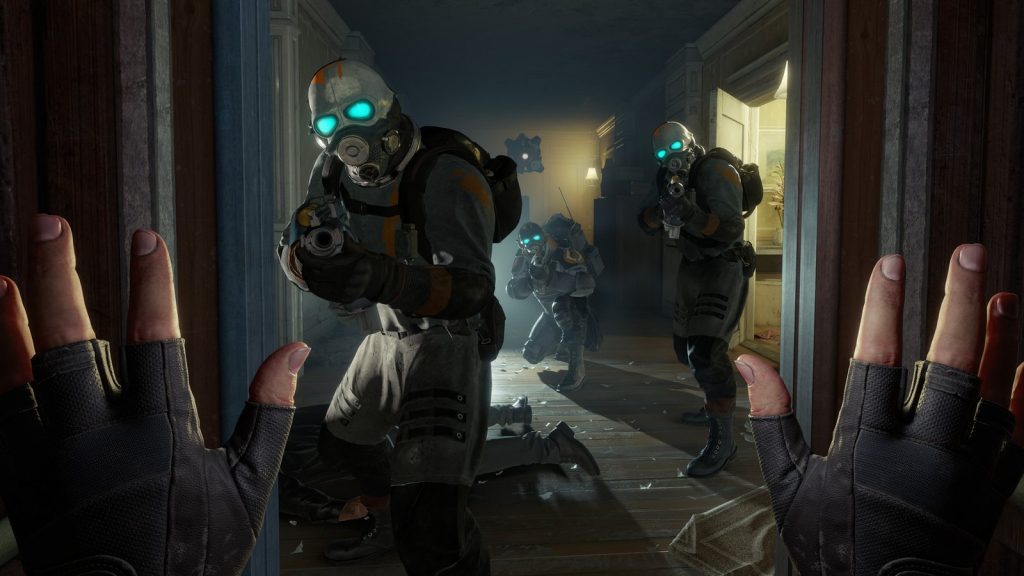
Valve’s answer was the gravity gloves, an in-world tool that echoes the famous gravity gun from Half-Life 2. You point at an object, hold the grip button, and flick your wrist toward yourself. The object pops into the air and flies toward you, and you catch it.
The design succeeds for several reasons:
- It is physical. The flick is a real gesture, and the catch is a real moment of coordination, so the action feels satisfying rather than automatic.
- It reduces strain. You rarely need to crouch to the floor or walk across a room for supplies.
- It fits the fiction. The gloves are part of Alyx’s equipment, not an invisible game system.
- It encourages exploration. Pulling items from shelves and drawers becomes a pleasure in itself.
Many later VR games adopted similar “force grab” mechanics, a sign of how well the solution worked.
Physical interaction everywhere
The broader achievement of Half-Life: Alyx is the density of its interactions. Most objects in the world respond to your hands in a believable way, and the game uses that to make ordinary actions memorable.
Reloading as an action
In most flat games, reloading is a button press. In Half-Life: Alyx, you eject a magazine, reach over your shoulder to take a fresh one from your backpack, slot it into place and, for some weapons, pull back the slide. Reviewers widely singled this out: a simple, repeated action becomes a skill that you get better at, and doing it under pressure gives encounters tension without relying on difficulty alone.
Inventory on your body
Rather than opening a menu, you store small items on your body, in wrist pockets and the backpack. Healing involves physically using a health device. Keeping inventory in the world keeps you immersed and makes item management feel natural.
Puzzles designed for hands
Alyx carries a multitool for interacting with Combine technology, and the game includes a range of hacking puzzles that only make sense in VR: tracing paths through 3D shapes floating in space, rotating holographic structures, and following circuits through walls. Other puzzles use the physical world, asking you to move objects, stack items or manipulate the environment. Because these puzzles use depth, rotation and the space around you, they feel distinct from flat-screen puzzles.
The world as a toy
Much of the game’s charm comes from objects that serve no purpose except to respond. You can open drawers, pick up bottles, draw on windows with markers and play a piano. These touches teach players that the world is worth touching, which in turn makes the purposeful interactions more rewarding.
Locomotion and comfort options
A major VR game has to accommodate players with very different tolerance for artificial movement. Half-Life: Alyx launched with several movement types, as reported by outlets that documented its options:
| Option | How it works | Comfort |
|---|---|---|
| Blink (default) | Teleport to a chosen spot with a brief fade | The most comfortable option |
| Shift | Teleport-like, but with a quick visible dash to the destination | Comfortable for many, slightly more motion |
| Continuous (head) | Smooth thumbstick movement in the direction you look | Requires more tolerance |
| Continuous (hand) | Smooth movement in the direction your controller points | Requires more tolerance |
Turning was handled with snap turning at launch, and an update added continuous (smooth) turning with adjustable speed, along with an option to disable stick turning entirely. The game also supports seated play with height adjustment options, and includes a single-controller mode for players who can only use one hand, along with subtitles and other accessibility settings.
Making teleport-style movement the default, while offering smooth movement for experienced players, became a widely cited model for VR comfort design. If these terms are unfamiliar, our guide to VR comfort settings explains each option, and our article on VR motion sickness covers why they matter.
Reception and awards
The game received exceptional reviews. It holds a Metacritic score of 93, and several outlets described it as VR’s killer app. Its awards include:
- Best VR/AR at The Game Awards 2020.
- Immersive Reality Game of the Year and Immersive Reality Technical Achievement at the 24th D.I.C.E. Awards.
- Game of the Year at the 2020 VR Awards.
Commercially, it was a major success for a VR-only title, with reported sales passing two million copies by December 2024.
How to play it today
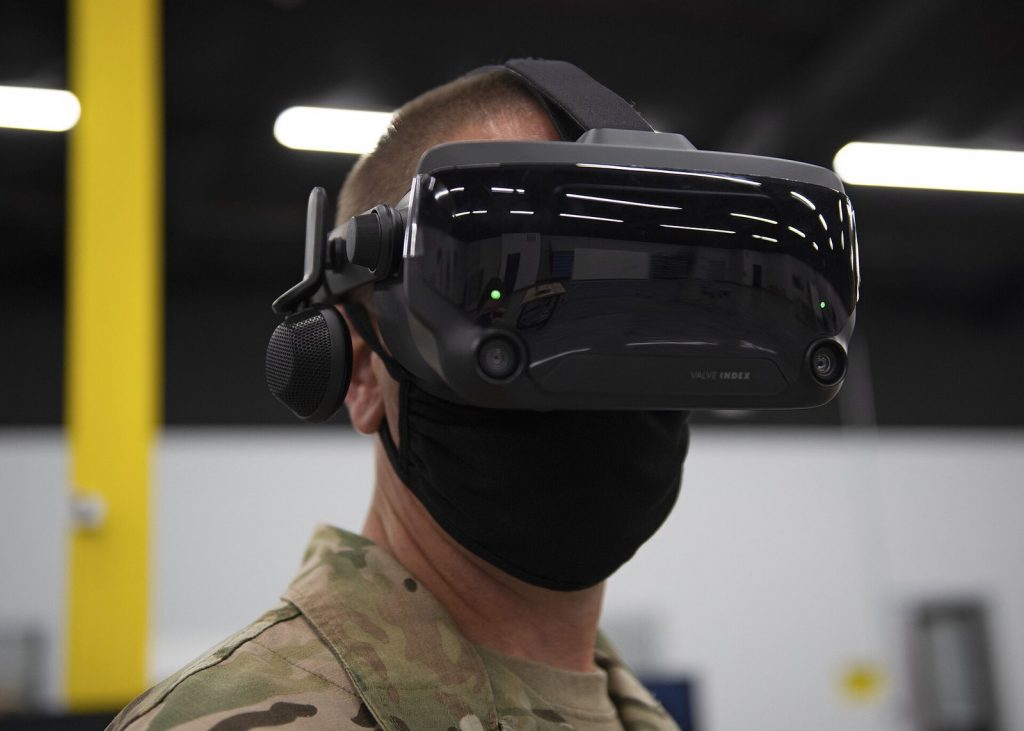
Half-Life: Alyx is a PC VR game. It is sold on Steam, labeled “VR Only,” and runs through SteamVR. That means you need a gaming PC that meets its requirements, plus a SteamVR-compatible headset. Supported headsets have included the Valve Index, HTC Vive, Oculus Rift and Windows Mixed Reality headsets.
Meta Quest owners can play it by connecting the headset to a capable PC, either with a cable or wirelessly over a good home network. In this setup, the PC runs the game and the Quest acts as a display. The game does not run natively on a standalone Quest or on PlayStation VR2’s console mode. Our comparison of standalone, PC and console VR explains why some games are tied to a PC. A dedicated guide to connecting a Quest to a PC is coming later in this series.
A few practical notes:
- Space: it works in standing and seated play; roomscale adds freedom but is not required.
- Session length: it is a full-length campaign. Plan for many sessions rather than one marathon.
- Tone: some sections are tense and dark. If you prefer to avoid intense moments, read reviews or content descriptions before playing.
Workshop and modding: a second life
Valve released Source 2 mod tools and Steam Workshop support for Half-Life: Alyx in May 2020, including the Hammer level editor. This allowed the community to create and share new levels, puzzles and experiences, which players can subscribe to directly through the Steam Workshop.
The most prominent example is Levitation, a free fan-made campaign released on the Workshop in November 2022. It continues after the events of the base game, with new levels, voice work and story, and is available to anyone who owns the game. Projects like this extended the game’s life well beyond its original campaign and demonstrated how powerful the tools were.
Modders have also experimented with the game in unexpected ways, including a fan project released in 2023 that makes it playable without VR hardware. It is an unofficial modification and changes the experience considerably, but it shows how much interest the game continues to attract.
Its influence on VR design
Half-Life: Alyx did not invent most of its ideas, but it combined them with a level of polish that set expectations. Its lasting lessons for VR design include:
- Solve physical strain with in-world tools, like the gravity gloves, rather than abstract menus.
- Make routine actions physical, so repetition becomes skill rather than chore.
- Keep inventory on the body to preserve immersion.
- Offer a full range of comfort options, defaulting to the most comfortable.
- Fill the world with responsive objects, because players will try to touch everything.
- Support creators, since community content can carry a game for years.
Years after its release, it remains the game many VR players point to when someone asks what the medium can do at its best.