Overcooked Explained: How Kitchen Chaos Became the Model Co-op Party Game
How Overcooked and Overcooked 2 work, from the prep-cook-plate-wash loop to star ratings, plus role tips and the series' influence on chaos co-op games.

Few games describe themselves as honestly as Overcooked. The premise is a kitchen, a queue of orders and a ticking clock. The reality is four people shouting about onions while the floor splits in half and someone sets the stove on fire. It is a cooking game in the same way a fire drill is a walk outside.
Since its 2016 release, Overcooked has become shorthand for a whole style of game, often called chaos co-op, and a reference point for anyone planning a couch co-op night. This guide explains how the series works, what changed in the sequel, how to divide roles and communicate, and why so many later games borrowed its formula.
Where Overcooked came from
Overcooked was the first game from Ghost Town Games, a small studio founded in Cambridge, England, by Phil Duncan and Oli De-Vine, who had previously worked at Frontier Developments. It was published by Team17 and released in August 2016 on PlayStation 4, Windows and Xbox One, with a Nintendo Switch version following in July 2017.
The game was a critical success for a debut. At the 13th British Academy Games Awards, it won the BAFTA for British Game and for Family, and it received nominations at The Game Awards 2016.
Overcooked! 2 followed on August 7, 2018, developed by Ghost Town Games together with Team17 and released on PC, Switch, PlayStation 4 and Xbox One. It won Best Family Game at The Game Awards 2018. In November 2020, Overcooked! All You Can Eat arrived on PlayStation 5 and Xbox Series X|S, bundling a remastered version of the original with the sequel and all of their downloadable content; it reached other platforms in March 2021.
The core loop: prep, cook, plate, serve, wash
Every Overcooked level runs on the same structure. Orders appear at the top of the screen, each showing a dish and its ingredients. Players must turn raw ingredients into finished meals and deliver them before the order times out. A level typically lasts a few minutes.
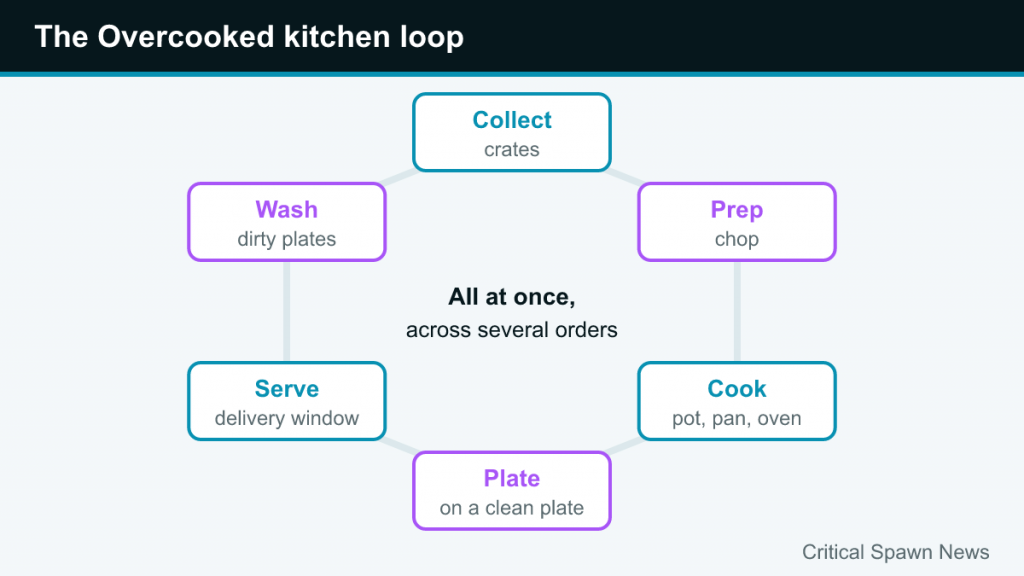
Making a dish involves a chain of steps, each done at a specific station:
- Collect raw ingredients from crates.
- Prep them, usually by chopping at a cutting board.
- Cook them in a pot, pan, fryer or oven. Leave food too long and it burns, and an unattended burning pan can start a fire that spreads.
- Plate the finished components together on a clean plate.
- Serve the plate at the delivery window.
- Wash the dirty plates that return, because clean plates run out quickly.
None of these steps is hard alone. The challenge is that they all happen at once, in parallel, across several orders, in a kitchen that rarely cooperates.
Moving kitchens
What turns the loop into chaos is the kitchen itself. Levels place stations far apart, separate counters with gaps or hazards, and frequently change mid-level. Across the original’s campaign kitchens, players work on moving trucks, drifting ice floes and busy crosswalks with pedestrians walking through. Counters slide apart, floors shift and routes close and open. A strategy that worked thirty seconds ago may suddenly be impossible.
Coins and star ratings
Successful deliveries earn coins, with bonuses for serving quickly, while incorrect or failed orders cost time and opportunities. At the end of each level, the coin total determines a rating of up to three stars. Stars unlock later levels in the campaign, so a team that scrapes by with one star will eventually need to return and improve. Three stars on later levels demands a genuinely well-organized kitchen.
What Overcooked 2 changed
The sequel kept the formula but made important additions:
- Online play. The original was local only. Overcooked! 2 added online matchmaking and play over local wireless, so friends no longer had to share a sofa. The All You Can Eat collection extended online play to remastered levels from the first game.
- Throwing. Players can throw uncooked ingredients to a teammate or directly into a pot. This one mechanic changed strategy considerably: a dedicated chopper can now feed a cook across the kitchen without walking.
- New kitchen gimmicks, including teleporting portals, magic levels and kitchens that move between locations.
- Versus mode, where two teams of two compete in mirrored kitchens.
- Downloadable content that added new levels, chefs, recipes and mechanics over time.
Both games support up to four players in local co-op, and both offer a single-player mode in which one person controls two chefs and switches between them. Store listings such as the Nintendo eShop page for Overcooked! 2 list single-system play for one to four players, plus local wireless and online play for two to four.
How to divide roles
New groups usually begin with everyone doing everything, which leads to four people chopping the same onion while the soup burns. Good teams split responsibilities. The exact split depends on the kitchen, but a few role patterns work across most levels.
Two players
- Prep and supply: collects and chops ingredients, keeps cooking stations fed.
- Cook and serve: watches pots, plates finished food, delivers orders and handles washing when there is a gap.
Three players
- Chopper: preps all ingredients.
- Cook: manages pots and pans and puts out fires.
- Plater and dishwasher: keeps clean plates available, assembles and delivers.
Four players
With four, a dedicated dishwasher or runner often helps, or the team can split into two pairs, each handling one side of a divided kitchen. Four players can also crowd each other in small kitchens, so sometimes the best move is for someone to stay out of the way.
Roles should be flexible. When a kitchen changes shape, the person closest to a task should take it, even if it is not “their” job.
Communication tips that actually help
Overcooked is ultimately a communication game. Teams that talk clearly improve quickly; teams that shout vaguely stay stuck. Some habits make a big difference:
- Call what you are doing, not just what you want. “I’m chopping tomatoes” helps more than “We need tomatoes!”
- Name the next order. Someone, often the plater, should read out what is coming next so the prep player can get ahead.
- Announce hand-offs. “Throwing lettuce left” prevents ingredients from landing on the floor.
- Warn about timers. “Soup is nearly done” or “Pan is burning” gives the cook a chance to react.
- Agree a plan in the first seconds. Before the level starts, glance at the layout and decide who goes where.
- Debrief between levels, briefly. One improvement per attempt is better than a long argument.
It is also worth remembering that failure is part of the fun. If a level is causing real frustration, move on and come back later; the campaign has plenty more.
Common beginner mistakes
- Forgetting the plates. Dirty dishes pile up silently until nobody can serve anything.
- Walking away from a pan. Burnt food leads to fires, and fires spread.
- Over-preparing. Chopping ingredients for orders that are not in the queue fills counters and blocks space.
- Ignoring the oldest order. Orders time out in sequence; serving the newest one first can mean losing the oldest.
- Everyone chasing the same task. If two people are heading for the same crate, one should turn around.
Why Overcooked became the model
Overcooked did not invent cooperative chaos, but it distilled a formula so clearly that it became the reference point for a whole wave of games. The ingredients of that formula are easy to spot:
- Simple controls: move, pick up or put down, use, and (in the sequel) throw and dash. Anyone can learn them in a minute.
- Clear but parallel tasks: each step is obvious, but there are too many to do alone.
- A shifting environment that forces constant re-planning.
- Short levels with clear ratings, making retries and player rotation easy.
- Visible, comic failure that turns mistakes into shared laughter rather than individual blame.
Later chaos co-op games adopted this template for other settings. Moving Out (2020), also published by Team17, swaps kitchens for houses and has players carry furniture to a removal van in a race against the clock, with similar physics comedy and up to four local players. Many other games have applied the formula to restaurants, workshops and spaceships. When reviews describe a new game as “Overcooked but with…”, they are acknowledging how completely the series defined the genre.
If you are planning a co-op evening and want to compare Overcooked with calmer or story-driven options, our guide to picking couch co-op games covers the alternatives. For the meaning of terms like local wireless and online co-op on store pages, see our multiplayer terms explainer.
Which version should you play?
| Version | Released | Online play | Best for |
|---|---|---|---|
| Overcooked | August 2016 | No (local only) | Historical interest; superseded by the remaster |
| Overcooked! 2 | August 2018 | Yes | Groups who want the sequel’s throwing and online play |
| Overcooked! All You Can Eat | November 2020 (PS5, Xbox Series), March 2021 (other platforms) | Yes | Anyone starting fresh: both games and all DLC in one package |
For most new players, the bundle is the simplest choice, since it collects both games and their extra content. Groups who already own Overcooked! 2 have the most important additions already.
Playing with kids and mixed groups
Overcooked is a popular family game, and its awards reflect that, but its time pressure can overwhelm younger or less experienced players. A few adjustments keep it fun for everyone:
- Give newcomers a single, clear job, such as chopping or washing plates, rather than asking them to follow the whole recipe chain.
- Replay early levels. Earning three stars on a simple kitchen is more satisfying for a mixed group than scraping one star on a hard one.
- Check accessibility options. The later releases added settings that make levels more forgiving, which can take the edge off the timer for younger players.
- Swap roles between levels so nobody is stuck washing dishes all evening.
- Celebrate the disasters. A burnt kitchen is a story to laugh about, not a failure to analyze.