Where Split-Screen Went: Why Couch Multiplayer Became Rare and Where It Still Thrives
Why many big games dropped split-screen, what developers have said about it, and where couch multiplayer is still alive and easy to find today.
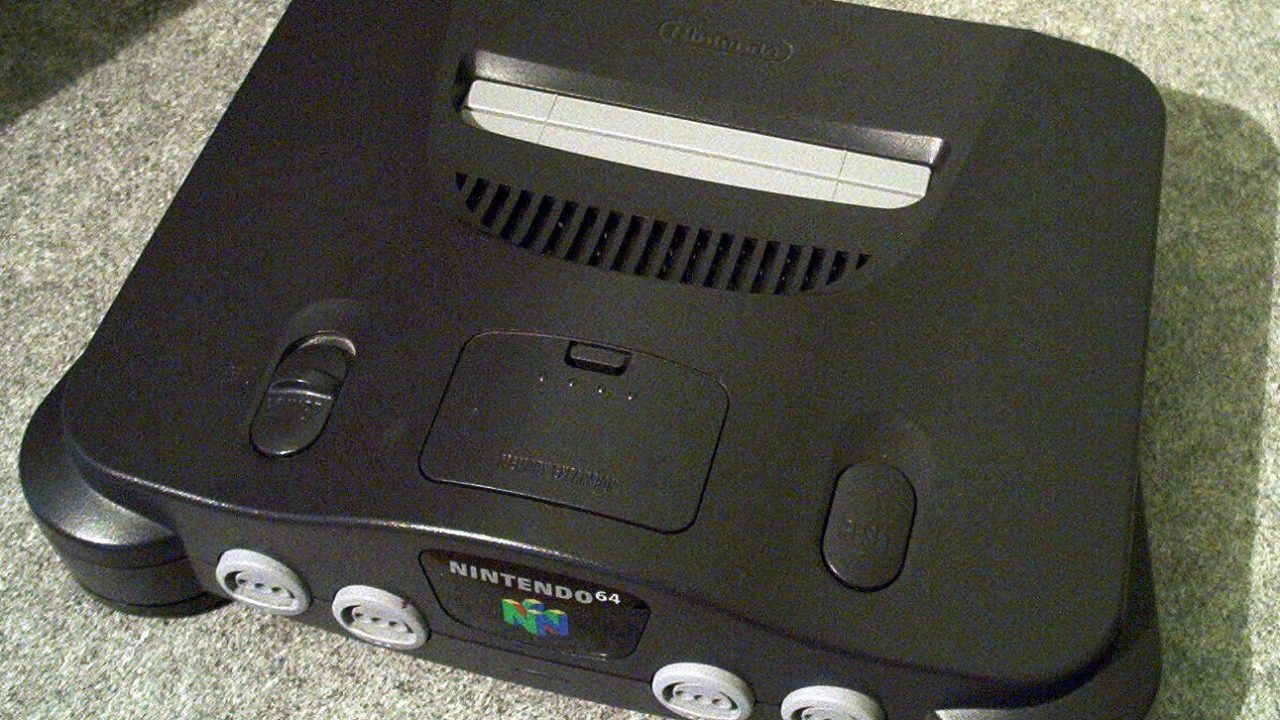
For a generation of players, multiplayer meant one television, two to four controllers and a screen cut into quarters. Sleepovers, dorm rooms and family living rooms were built around it. Today, many of the biggest releases have no split-screen at all, and buyers increasingly have to check the fine print to find out whether a friend on the sofa can join. Split-screen has not vanished, though. It has moved, concentrating in particular genres and studios. This article looks at the reasons it became rarer, what developers have said publicly, and where to find it now.
What Split-Screen Actually Asks of a Game
To understand why studios drop split-screen, it helps to know what it requires. In a shared-screen game, all players appear in one view, so the game renders one camera. In split-screen, each player has their own camera, and the game has to draw the world separately for each of them every frame.
That has several consequences:
- More rendering work. Two views roughly means drawing the scene twice; four views means four times. The resolution of each view is smaller, but much of the per-scene work, such as processing objects, lighting and effects, still multiplies.
- More of the world loaded at once. If two players can wander to opposite ends of a large map, the game may need to keep both areas ready simultaneously.
- Interface redesign. Menus, maps, subtitles and HUD elements designed for a full TV have to be reworked for half or a quarter of the screen.
- Extra testing. Every feature has to be checked with multiple local players, separate profiles and controllers, which adds quality assurance time.
None of this makes split-screen impossible. It means split-screen competes for the same performance budget and development time as everything else in the game. If you need a refresher on the terminology, our explainer on local co-op, online co-op and split-screen covers the differences between shared screen, split-screen and online play.
The Main Reasons It Became Rare
There is no single cause. Public statements from developers and years of industry reporting point to a combination of factors.
1. Rising visual expectations
As each console generation pushed for higher resolutions, more detailed worlds and more complex effects, the cost of rendering a second, third or fourth view grew with it. A game designed to use a console’s full performance for one view has little headroom left for more. Studios then face a choice between lowering visual quality in split-screen, cutting the mode, or investing heavily to make it work.
2. Online play became the default
When broadband internet and console online services became widespread, playing with friends no longer required being in the same room. Publishers increasingly built multiplayer around online matchmaking, persistent progression and voice chat. Local play remained valued by many fans, but it was no longer the only way to play together, which made it easier to justify cutting.
3. Development focus and priorities
Developers have explicitly framed the decision in terms of focus. When 343 Industries confirmed in 2015 that Halo 5: Guardians would not include split-screen, reporting tied the decision to the studio’s 60 frames-per-second target, and the studio later explained the choice in terms of scale, fidelity and focus, saying that the time needed to optimize for split-screen would take attention from other parts of the game. In September 2022, the same studio announced it was no longer working on local split-screen campaign co-op for Halo Infinite, saying it had reallocated resources toward its live-service plans. Those announcements drew strong reactions from fans precisely because the series had been so associated with couch play.
4. Business models built around individual accounts
Many modern games are built around online accounts, cosmetic progression and individual purchases. Split-screen guests complicate that structure: a second local player may not have an account, may not own the game, and may not progress in the same way. That is a design challenge rather than an absolute barrier, but it is one more reason a mode can slip down the priority list.
5. Multiple hardware targets
When a game ships on several consoles and PC at once, the weakest target can shape what is feasible. A split-screen mode that runs well on one machine may not fit within the memory or performance limits of another, and publishers often prefer consistent features across platforms.
Where Split-Screen Still Thrives
Despite all of this, local multiplayer has carved out clear strongholds. In several genres it is not an afterthought but the reason the game exists.
Co-op adventures built for two
The most prominent example is Hazelight Studios, whose games are designed exclusively for two players and present split-screen even when the two players are online. It Takes Two and Split Fiction treat the split as a storytelling device, sometimes merging or reshaping the screen for dramatic effect. Our Hazelight Studios explainer covers how this design works and how the Friend’s Pass lets a second player join without owning the game.
Party and chaos co-op games
Games like Overcooked and its imitators keep everyone in a single shared view, which sidesteps most of split-screen’s performance cost while keeping the energy of a room full of players. Many small party games follow the same approach: one camera, short rounds, simple controls.
Indie local multiplayer
Independent developers have kept couch play alive in arena games, puzzle co-op and farming or life-sim games. Smaller scope and stylized art make additional views far cheaper to render, and couch multiplayer helps a small game stand out. A well-known example of local play being added after release is Stardew Valley’s 1.5 update, which introduced split-screen co-op on PC in December 2020, with console versions following in early 2021.
Family and hybrid console culture
Nintendo’s hybrid consoles made local multiplayer part of the hardware itself. Detachable controllers that can be split between two players, plus tabletop play on a single screen, mean many Switch-family owners expect a second player to join without buying another device. Many third-party and indie games on those systems lean into local multiplayer as a result.
Family-friendly licensed games
Co-op adventure games aimed at families, such as the long-running LEGO game series, have long offered drop-in local co-op, often with dynamic split-screen that merges into a single view when players are close together.
Shared Screen vs Split-Screen: Not the Same Thing
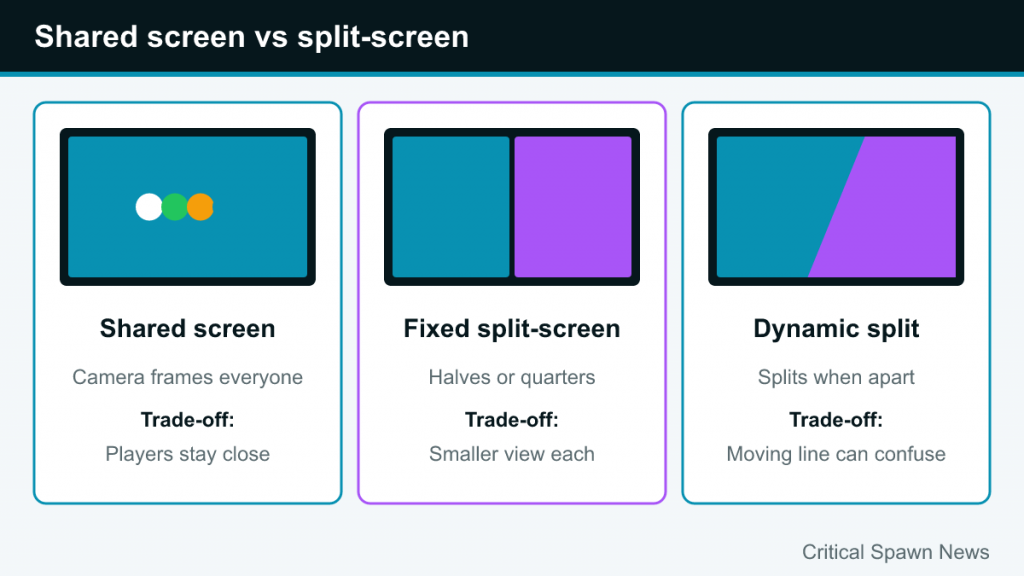
When shopping for couch multiplayer, it is worth separating two features that stores sometimes group together:
| Feature | How it works | Typical genres | Trade-offs |
|---|---|---|---|
| Shared screen | All players in one view; camera frames everyone | Party games, platformers, puzzle co-op, arena games | Players must stay close together |
| Fixed split-screen | Screen divided into halves or quarters at all times | Co-op adventures, older shooters, racing-style games | Smaller view per player; more performance cost |
| Dynamic split-screen | One view when players are close, splits when they separate | Family co-op adventures | Can be disorienting when the split line rotates |
Many games that are described as “local co-op” are actually shared-screen, which is often more comfortable on smaller TVs.
How to Find Games With Split-Screen Today
Because split-screen is no longer a default, buyers need to check before purchasing. A few practical habits help:
- Use store feature filters. Steam lists features such as Shared/Split Screen, Shared/Split Screen Co-op and Shared/Split Screen PvP, and you can filter search results by them. Console stores show supported play modes on product pages, though the labels vary by platform.
- Read the feature list, not just the trailer. “Co-op” on its own usually means online. Look for explicit mentions of “local” or “split-screen.”
- Check the player count per mode. A game might support four players online but only two locally.
- Check per-platform details. Local multiplayer support can differ between console versions and PC, and some features arrive in later updates.
- Look for community lists. Fan-maintained databases of couch co-op games are often more detailed than store pages, but verify with the official listing before buying.
Streaming as a workaround
On PC, Steam’s Remote Play Together lets friends join a game’s local multiplayer mode over the internet, even if only the host owns the game. It does not add split-screen to games that lack it, but it gives local-only games a second life online. That system has enough nuance to deserve its own explainer later in our co-op coverage.
Common Myths About Split-Screen
“Developers just don’t care anymore”
The public statements that exist tend to describe trade-offs, not indifference. Split-screen costs real performance and development time, and studios weigh it against other features. Fans may disagree with those decisions, but they are usually deliberate.
“Modern hardware is so powerful it should be trivial”
Hardware has grown more powerful, but so have the demands of single-player visuals. If a game is tuned to use most of the available performance for one view, adding more views still forces compromises.
“Split-screen is dead”
It is less common in the biggest blockbuster releases, but it remains a core feature in co-op adventures, family games, party games and much of the indie scene. Some of the most celebrated co-op games of recent years are built entirely around it.
What Couch Multiplayer Offers That Online Play Doesn’t
The reasons people still seek out split-screen are social rather than technical. Sharing a room means instant communication, shared reactions and an easier way to introduce someone new to games. A parent can sit next to a child, a partner can learn alongside a more experienced player, and friends can play without everyone needing a console, a copy of the game and an online subscription. For planning those sessions, our guide on how to pick couch co-op games walks through player counts, skill gaps and session length.
Split-screen became rarer for understandable reasons, but it has not disappeared. It has simply become a feature you choose deliberately, and a growing number of developers build entire games around the idea that the best place to play together is still the same sofa.